
 Freight Allocation
 Real-time Visibility
 Time Slot Management
 Performance & Market Reports
 Agriculture
 Steel & Construction
 FMCG
FMCG Automotive
 Paper & Packaging
 Retail
 Wood & Furniture
 Case Studies
 Blog
Blog Reports


Blog
New
Market Insights ON Q4/2026: The real cost of waiting at the dock
Truck waiting time at the loading dock looks like a carrier's problem. The new Market Insights ON shows it is a revenue problem for shippers, worth up to 3% of annual turnover. We look at why rigid time slots backfire, how AI is cutting waiting times by up to a quarter, and how Italy, Spain and Romania are changing the rules at the ramp.


All categoriesAIAutomationBest PracticesDigitalisationDock ManagementEventsIndustry NewsLogistics TrendsPlatform UpdatesSupply Chain VisibilitySustainabilityTransport Management
When a flash promotion breaks your supply chain
Flash promotions are creating shorter, sharper and less predictable demand peaks, just as Europe's road freight market runs short of trucks and drivers. We asked logistics leaders from retail and top-tier logistics operators how they keep shelves stocked when demand spikes overnight.

The Cost of Waiting: The Hidden Impact of Dock Delays on Agri-Food Shippers in Europe
Every hour a truck waits at a silo drives up labour costs, erodes product quality and raises freight rates. Here is why bulk operations are especially exposed, and how digital dock scheduling turns delays into a competitive advantage.
Smart ways to overcome spot capacity bottlenecks while protecting your SLAs
When seasonal surges hit or primary carriers run out of space, finding trustworthy spot capacity becomes a costly bottleneck. Here is how logistics leaders protect SLAs and streamline carrier vetting without burning out their teams.

The Great Squeeze: Why Road Freight Rates Are Surging Across Europe
The era of cheap, easily accessible transport capacity is over. In this environment, carriers and shippers must move from reactive cost-cutting to active profitability management.

New Routes: fewer disputes and greater control over transport costs
The traditional approach to transport contracts is no longer suited to the realities of a dynamic market. Today, instead of rigid provisions that are difficult to change, flexibility is what matters. Also the ability to quickly adjust rates and respond efficiently to sudden spikes in orders.
The "no freight exchanges" clause was meant to protect the load. Today it may block the delivery
Drawing a distinction between the open spot market and a closed, certified carrier exchange makes it possible to combine both objectives — security and continuity of supply — instead of choosing between them.

The diesel crisis is your problem too as a shipper (even if you're not the one driving)
Diesel is more expensive, and it's not just about the price of oil. Here's how that pressure reaches you even if you're not the one filling the tank, and what you can do so you don't end up without capacity when you need it most.

Logistics automation for shippers: how to stop chasing trucks
If your logistics team is still tracking carrier compliance in a spreadsheet and managing exceptions over the phone, you already know the toll it takes. Manual logistics operations don't fail all at once. They fail incrementally—in the three hours consumed by endless phone calls per shipment, or the truck that arrives at a dock that simply isn't ready for it.

How to find a verified carrier in minutes with the Certified Carrier Exchange
When your trusted carrier can't take the load, finding a verified replacement shouldn't take days. Here's how CargoON shippers use the Certified Carrier Exchange to source TAPA-certified capacity in minutes.

NCT Group enters into a strategic partnership with CargoON
NCT Group has partnered with CargoON to accelerate the digitalization of its transport operations across Europe. The collaboration will support more efficient freight execution, improved carrier communication, and greater visibility through automation and centralized transport management.
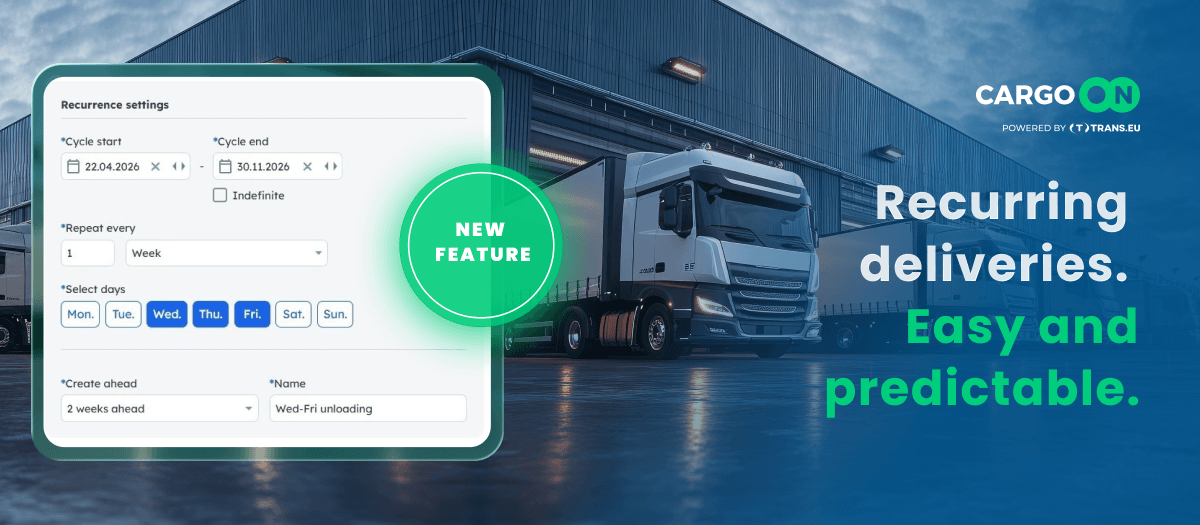
Recurring time slots for your key customers with CargoON new feature
Recurring time slots are created automatically, so you no longer need to repeat the same steps manually.
No surprises at the dock with CargoON new features
Time-slot forwarding and order consolidation speed up unloading and reduce manual labour.