CargoOn >
Resources >
Blog >
New Routes: fewer disputes and greater control over transport costs New Routes: fewer disputes and greater control over transport costs
The traditional approach to transport contracts is no longer suited to the realities of a dynamic market. Today, instead of rigid provisions that are difficult to change, flexibility is what matters. Also the ability to quickly adjust rates and respond efficiently to sudden spikes in orders.
9/10/2026
That is why we redesigned the Fixed Routes module (now “Routes”) to give you real control over transport costs, not just administrative convenience. See exactly what we have changed.
1. Cooperation without unnecessary formalities to get started
Until now, launching a regular route required going through several stages. Even if you weren’t yet ready for a permanent contract, the system forced you to enter numerous terms just to get started.
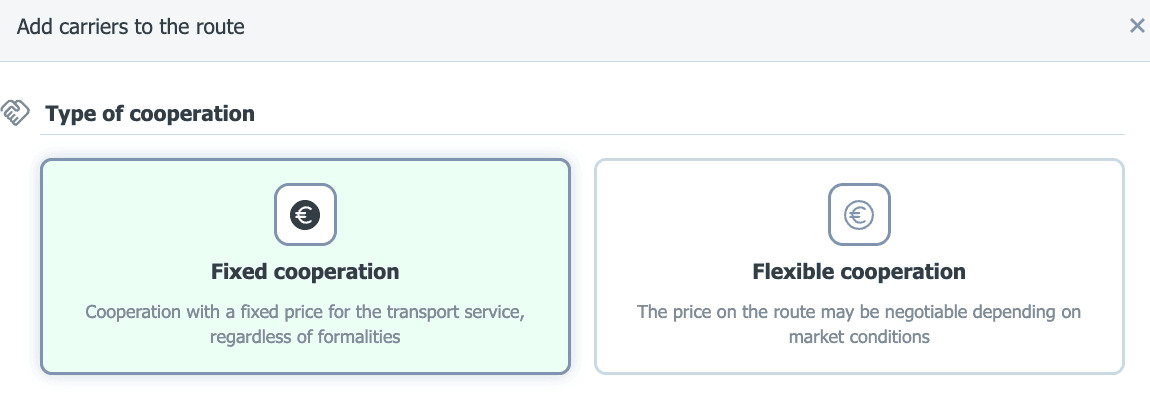
How it works now: You simply choose a carrier and get started. You can activate flexible cooperation in just a few steps - without setting a final price. Once the relationship starts working well and prices on the route stabilise, you can switch to a fixed rate at any time. This saves you time on constant negotiations and gives you flexibility without the risk of overpaying for rates fixed at a time when the market has not yet stabilised.
2. Trusted partners for the peak season
Ensuring the right number of vehicles is a perennial challenge: will you contract too few carriers and be left without vehicles during the peak season? Or will you contract too many and not give them enough work, causing them to turn to the freight exchange?
How it works now: You can create a separate pool of carriers operating on a flexible basis — without a fixed price. How you use it depends on your strategy. For some, it will be a safety buffer for the peak season, activated only when the workload suddenly increases. For others, it will be a constant price benchmark: a pool of carriers whose rates you regularly compare with your contract rates to verify on an ongoing basis that you are not overpaying. You can also take it a step further and base your entire cooperation on this model — without locking prices into contracts and responding flexibly to what is happening on the market.
Regardless of the approach, the result is the same: you have vehicles at hand and a real point of reference that helps keep transport costs under control — instead of paying rates that stopped reflecting the market long ago.
3. All rates and prices in one place
No more manually re-entering data or checking in Excel whether a given route is profitable for you.
How it works now: On the route list, you can see everything at a glance: the average of your contract rates, current market prices and information on how many transports you planned versus how many actually went ahead. You have one reliable source of information right in front of you. You immediately know whether it is time to negotiate the price, add a new carrier or leave the route as it is. This is where you will see quickest whether a given route is no longer profitable.
4. Per-kilometre billing and round-trip routes
This is a major change for companies that are billed based on the kilometres driven (e.g. on circular routes with multiple collection points, known as a milk run).
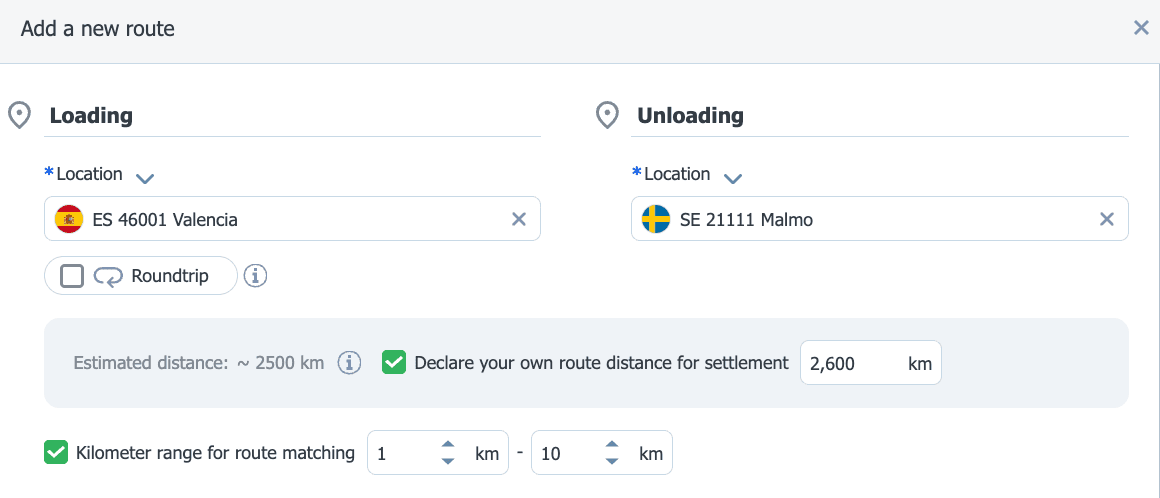
How it works now: You can base your contract with the carrier directly on a per-kilometre rate. The system automatically handles and closes Roundtrips (i.e. round-trip routes). Importantly, if the system map calculates the kilometres incorrectly for your specific route, you can override the automatically determined distance with your declared distance. This will be accepted as the basis for further transport cost calculations.
5. Quickly matching freight to an existing rate (Route ID)
It is not always worth creating a new route and rate for every new loading or unloading location—especially when, in practice, the transport is comparable in cost to one that has already been negotiated.
What’s changed: We have introduced a unique route identifier (Route ID), which can be used to manually indicate a given route—even if the parameters of the new freight do not match the contractual terms 100%. This allows you to publish freight using an existing rate (flat-rate or per kilometre) instead of setting up another route from scratch. This saves time during configuration and, more importantly, ensures consistent, controlled transport costs instead of fragmenting rates across dozens of nearly identical routes.
6. No more disputes with carriers over kilometres
Disputes over how many kilometres a vehicle actually travelled are one of the most common causes of claims when invoices are settled.
What’s changed: We have introduced clear rules defining whose data takes precedence: your distance -> GPS data -> the carrier’s indication. The system knows which value is final and uses it as the basis for approving the settlement. Forget about arguing by email and checking every invoice manually. Fewer disputes mean not only time savings, but also fewer unjustified invoice surcharges.
7. Contracts tailored to large companies (amendments and versions)
We have adapted the system to the realities of how large logistics departments operate.
What’s changed: Contracts now support precise weight and payload capacity ranges (both from and up to a given value), as well as time zones. The most important improvement, however, is easy contract amendment. You can create successive versions of the same contract (new rates, new dates) without interrupting your existing work or losing the history of previous arrangements. Easy amendments mean you can keep rates up to date instead of paying according to outdated terms until the end of the contract.
What does this mean for your business?
Individually, these features are simply convenient options. Together, however, they offer much more: greater visibility into current vehicle availability, a real-time benchmark for market rates and a solid basis for making informed decisions — partly supported by selected automations. The result? Fewer overpriced routes, fewer invoice disputes and genuine, systematic optimisation of transport costs.

 Freight Allocation
 Real-time Visibility
 Time Slot Management
 Performance & Market Reports
 Agriculture
 Steel & Construction
 FMCG
FMCG Automotive
 Paper & Packaging
 Retail
 Wood & Furniture
 Case Studies
 Blog
Blog Reports