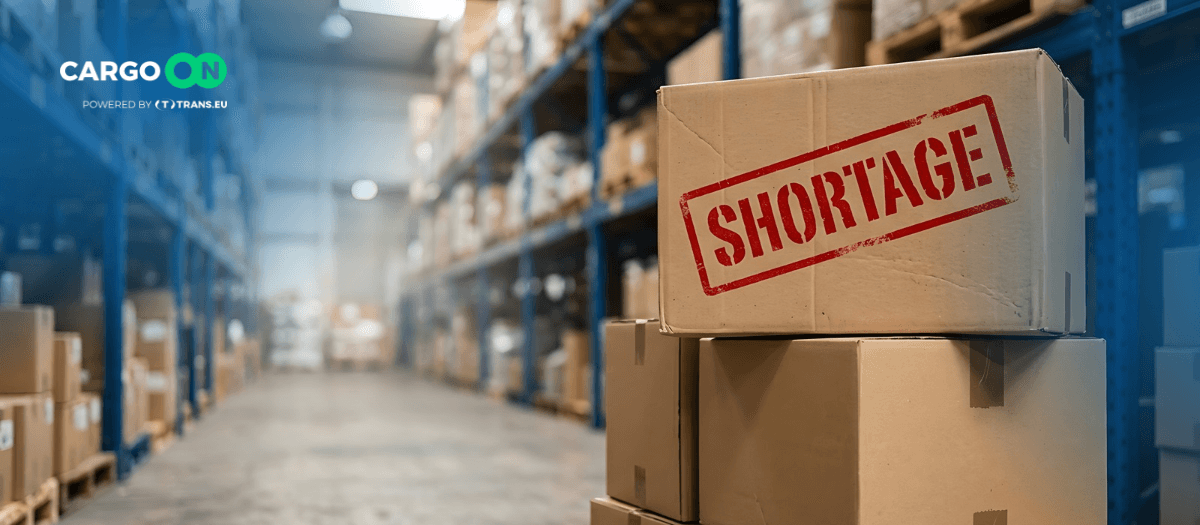
Flash promotions are creating shorter, sharper and less predictable demand peaks, just as Europe's road freight market runs short of trucks and drivers. We asked logistics leaders from retail and top-tier logistics operators how they keep shelves stocked when demand spikes overnight.
10/15/2026Author: Ricardo Lucientes Pastor
On Monday, marketing launches a 72-hour promotion. By Tuesday morning, store orders have doubled across three regions. On Wednesday, your usual carrier tells you they have no more trucks available that week. And on Thursday, with the promotion already over, you still have pallets waiting at the dock and stores with empty shelves.
If you run retail operations, this scene will sound familiar. It's not a planning failure. It's the new shape of demand: more frequent peaks that are shorter and harder to predict. And they're hitting a transport market that, across Europe, has less and less room to absorb them.
For this article, we gathered insights from logistics and transport managers at major retail companies and top-tier logistics operators, who spoke openly thanks to anonymity: a large European DIY and home improvement chain, a European housewares manufacturer supplying major retail chains, a hardware and industrial supplies distribution centre, and a logistics operator specialising in retail transport. Each one brings a different way of tackling the problem. Together with data from the European market, their answers paint a fairly clear picture of what's happening and what actually works.
Peaks no longer give warning
For years, peak season was predictable: sales, back-to-school, Black Friday and Christmas. You prepared weeks in advance and negotiated extra capacity with your suppliers. Today, those classic peaks are joined by flash promotions, retailer-specific special days and digital campaigns decided almost on the fly.
The logistics project manager at a top-tier logistics operator sums it up: the main challenge is high demand volatility, with day-to-day fluctuations that are hard to anticipate. The direct consequence is that waiting times at distribution centres become highly variable, routes get redone on the go, and teams end up working reactively, making decisions based on things that have already happened rather than on reliable forecasts.
The logistics director of a hardware distribution centre adds another layer to the problem: orders are getting smaller, more frequent and more urgent. In other words, the peak doesn't just arrive all at once; it arrives in fragments.
This isn't a local phenomenon. In European e-commerce, Sendcloud data pointed to increases of up to 72% in shipping volume during Black Friday week. And that volume doesn't stay in parcel delivery: before reaching the end customer, someone has to move the goods from suppliers and warehouses to hubs and stores. That happens by truck. Like it or not, road freight is still the main way our shelves stay stocked and our warehouses stay supplied.
And the trend is growing. According to the European E-commerce Report 2026 by Ecommerce Europe and EuroCommerce, B2C e-commerce in Europe reached €911 billion in 2025, up 7% on the previous year. The forecast for 2026 is around €961 billion, a 5% increase. Growth is slowing, but make no mistake: that's roughly €50 billion extra in a single year, which translates into more orders, more fragmented, with shorter lead times.
Our take is that this slowdown doesn't ease the problem; it makes it worse. In a market that's growing less, the battle is fought on price and promotions, and that means more flash campaigns switched on in a matter of hours.
The cost of an empty shelf
When transport doesn't arrive on time, the problem doesn't stay at the dock. It ends up on the shelf. The latest data makes this clear. The OSA (On-Shelf Availability) Barometer, produced by AECOC, the Spanish association of manufacturers and distributors, in collaboration with NIQ (NielsenIQ), estimates that in June 2026, large-scale retail in Spain lost 4.3% of its potential FMCG sales due to out-of-stocks, and that 31% of those lost sales were linked to promotional activity. Put another way: almost a third of what's lost to stockouts is lost precisely during promotions, which is exactly when the most money has been spent to attract customers.
For an operations director, the conclusion is uncomfortable but clear: a promotion that isn't backed by logistics capacity doesn't just lose sales. It also burns margin, marketing budget and customer trust.
Europe: fewer trucks just when you need them most
The underlying problem is that transport capacity in Europe isn't keeping pace with volatility. Quite the opposite. According to IRU's latest driver shortage report, Europe has around 502,000 unfilled truck driver positions, 13% of the required workforce. On top of that, about 20% of European drivers will retire within the next five years.
But the figure that should worry an operations director most is a different one: roughly two out of three European carriers admit they have turned down new contracts because they couldn't find drivers.
Add to that a fleet that isn't being renewed fast enough. New truck registrations in the EU fell by 6.2% in 2025.
And capacity isn't only lost through the driver shortage. It's also lost through how we use the trucks we do have. According to Eurostat data, around one in four kilometres driven by trucks in Europe is driven empty. Waiting times at loading and unloading remain one of the biggest productivity drains: in Italy, a Federtrasporti study based on tachograph data found that drivers spend on average more than four hours a day loading, unloading and, above all, waiting.
The problem is so serious that Italy has set a 90-minute limit on dock waiting time, with compensation for the carrier if it's exceeded. In Spain, regulations have for years provided for compensation when vehicles are held up for more than an hour at the dock. During a demand peak, that congested dock becomes a double bottleneck: a truck waiting three hours at your distribution centre is a truck that isn't available for its next job. Carriers know this, and they factor it in when deciding which customer to serve first.
What this means in practice: when you launch a promotion, you're no longer just competing for the end customer. You're competing for the same trucks as your competitors, who often run their campaigns the very same week. At that point, a carrier with limited capacity will prioritise the customer who pays best, the one they have the best relationship with, or the one who warned them first.
European market analysts describe a clear trend: shippers are increasingly combining contracts to cover their base volume with the spot market for flexibility. In fact, at the end of 2025, contract rates rose sharply as many shippers rushed to lock in capacity ahead of the expected recovery in demand.
What the best performers do
What's interesting about the answers we gathered is that, although each company has a different model, they all agree on a handful of levers.
Plan ahead and share information. Share forecasts, flag campaigns and peaks early, and book capacity with partners before the need arises. A stable relationship with carriers who know your operation is far more effective than going out to the market looking for capacity when everyone else needs it too.
Don't rely on a single provider. Not depending on just one carrier is a lesson many companies learn at the worst possible moment.
Diversify capacity. Combining external partners with an expanded dedicated fleet, collaborating with other players, using duo trailers and bringing store shipments forward are just a few ways to diversify capacity.
Get more out of every truck. Consolidate volumes, maximise full loads, improve pallet utilisation and match the transport mode to the actual volume of each shipment. In a market where capacity is scarce, the truck that doesn't leave matters as much as the one that leaves full.
Visibility and control. Some have opted for a track & trace tool with a dedicated control team and coordination between operations and stores. Others work with a control tower and automatic alerts for delays or incidents. Artificial intelligence comes up in every single answer, but always with a practical focus: anticipating problems, managing by exception and freeing up the team from admin tasks.
The hidden cost of reacting too late
A low rate stops being low when it leads to delays, failed deliveries, claims or extra admin work. During a demand peak, the real cost of transport isn't just on the invoice. It's in sales lost to in-store stockouts, in the overtime your traffic team spends making calls, in trucks waiting at the dock, and in the promotion that doesn't deliver what sales and marketing were counting on. Paying a bit more for a truck that's available on time is usually much cheaper than not having one at all.
,,
Ricardo Lucientes Pastor
Strategic consultant in road freight transport
A flash promotion lasts three days; the capacity to deliver it is built over months.
,,
Three questions before your next promotion
Before launching your next campaign, I recommend sitting down with your team and answering three questions:
How much additional volume can your usual network really absorb? Not what they promise on paper, but what they've proven in recent peaks.
How long does it take you to find alternative capacity if a provider lets you down? If the answer is measured in hours and dozens of phone calls, you're running a serious risk.
Do you hear about promotions early enough? If operations finds out about a campaign at the same time as the customer, the problem starts long before transport.
CargoON: capacity when your usual network falls short
No platform can single-handedly solve Europe's driver shortage. But it can make a big difference to how quickly you react when demand spikes. That's where CargoON, the shipper transport management platform from the Trans.eu Group, comes in. It lets you work in one place with your regular carriers, organised into private groups, and tap into a network of around 25,000 verified carriers across Europe whenever you need to. In other words, your trusted network remains the foundation, and the spot market becomes a second layer of capacity for the moments when the first one isn't enough.
You can also add automation to load allocation, shipment visibility and digital dock appointment management.
The key isn't to replace your relationships with carriers, but to avoid depending on them alone when a promotion turns all your forecasts upside down in 48 hours.

 Freight Allocation
 Real-time Visibility
 Time Slot Management
 Performance & Market Reports
 Agriculture
 Steel & Construction
 FMCG
FMCG Automotive
 Paper & Packaging
 Retail
 Wood & Furniture
 Case Studies
 Blog
Blog Reports