 Freight Allocation
 Real-time Visibility
 Time Slot Management
 Performance & Market Reports
 Agriculture
 Steel & Construction
 FMCG
FMCG Automotive
 Paper & Packaging
 Retail
 Wood & Furniture
 Case Studies
 Blog
Blog Reports


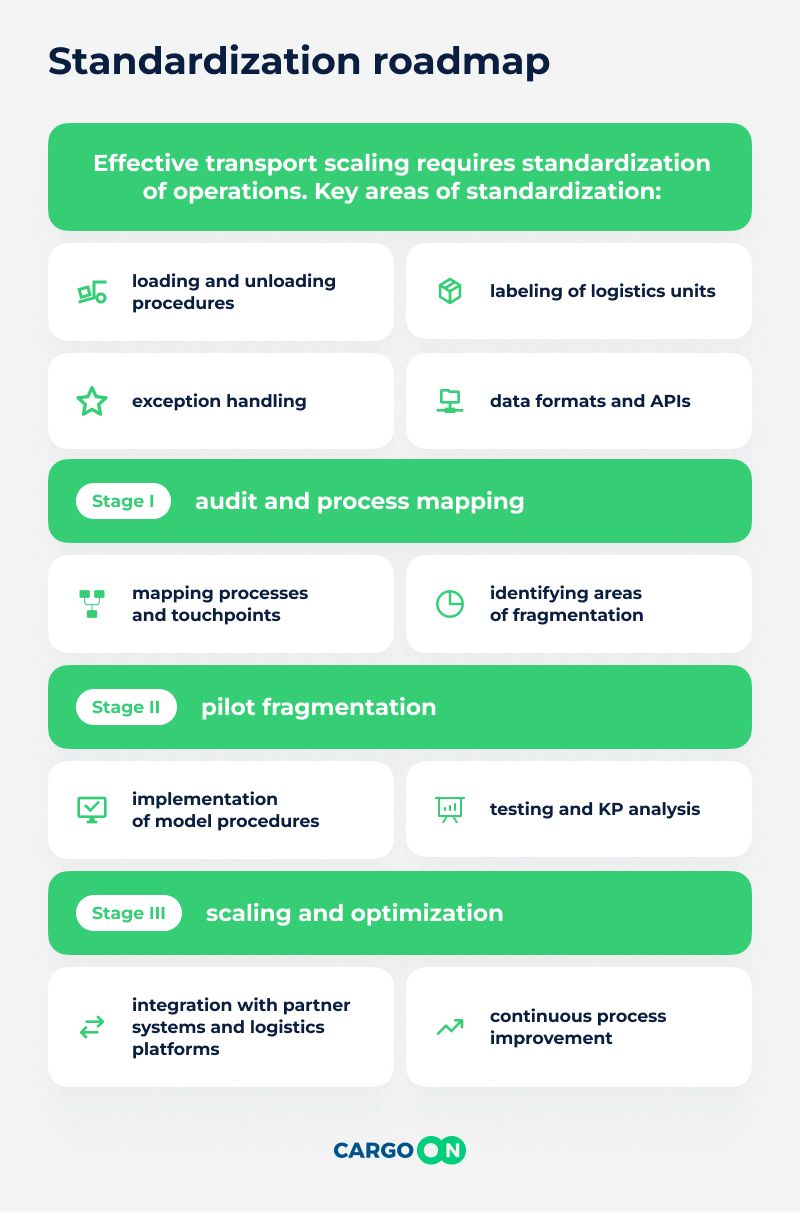
Effective scaling of transport in the global supply chain requires unification of operations. Key areas of standardization include:
- loading and unloading procedures,
- labeling of logistic units,
- exception handling,
- data formats and API.
Implementing comprehensive standardization in logistics requires a phased action strategy. Therefore, a standardization roadmap is needed to help manufacturing companies define a clear path from disparate processes to a fully integrated and scalable logistics system.
The roadmap below, based on industry practices and source research, outlines three main phases of digital transformation.
Stage I: Audit and process mapping
The first step is a thorough analysis of existing operations and systems. The audit aims to identify key touchpoints with supply chain partners and areas of greatest fragmentation and inconsistency.
Key questions the organization should answer:
- What standards and protocols are currently in use?
- Where are the biggest gaps or duplicate processes?
- Which operations generate the highest administrative costs or delays?
The analysis should also cover alternative costs resulting from a lack of standardization, such as the time-consuming nature of manual arrangements or the risk of data errors. It is recommended to develop a process map and classify it in accordance with industry best practices
Stage II: Pilot implementation
The second phase involves introducing standards in selected transport corridors or relations with the most important trading partners. The pilot will allow testing of the assumptions without incurring the full implementation costs.
Key activities:
- Selection of key logistics partners (e.g. 3PL, warehouse operators, carriers).
- Implementation of specific standards (e.g. GS1 labels, EDI, unified loading and unloading protocols).
- Implementation of TMS or logistics management platforms (e.g. CargoON).
- Establishing KPIs (lead time, unit cost, operational error rate) and monitoring results.
The pilot should be concluded with a comparative report that will serve as the basis for a decision on further scaling
Stage III: Scaling and optimization
The final phase involves extending the implemented standards to the entire logistics network and full integration with IT systems (TMS, ERP, WMS).
At this stage, the organization should:
- Provide training for all participants in the process.
- Implement tools for automating reporting and data exchange.
- Create a team for change management and process compliance audits.
The best results are achieved by companies that view standardization as a continuous process subject to regular evaluation and improvement. The organizational culture should support the adoption of new practices and their ongoing improvement.