 Freight Allocation
 Real-time Visibility
 Time Slot Management
 Performance & Market Reports
 Agriculture
 Steel & Construction
 FMCG
FMCG Automotive
 Paper & Packaging
 Retail
 Wood & Furniture
 Case Studies
 Blog
Blog Reports



In logistics, the breakthrough is expected to be the European Mobility Data Space (EMDS), an EU initiative aimed at integrating fragmented transport data sources into a single interoperable ecosystem. EMDS is not a central database but a set of legal, technical, and organizational frameworks that enable information exchange between different entities based on trust, interoperability, and regulatory compliance.
In the context of the transport industry, this means the ability to connect data from multiple sources, such as:
- TMS and WMS systems,
- customs platforms and eCMR,
- track & trace solutions,
- loading planning systems.
Currently, this data often exists in inconsistent formats, requires manual integration, and does not provide full \”end-to-end\” visibility of processes. EMDS aims to remove these barriers through the standardization of formats and data federation.
Business benefits and regulatory compliance
Thanks to EMDS, logistics companies, carriers, and manufacturers will gain:
- greater transparency of operations and supply chains (visibility),
- better planning and optimal resource utilization,
- faster response to disruptions,
- compliance with EU regulations such as the Data Act.
EMDS is part of the Sustainable and Smart Mobility Strategy and the European Data Strategy. The European Union has allocated over €25 million to this project, including for pilots and proof-of-concepts to test solutions in practice.
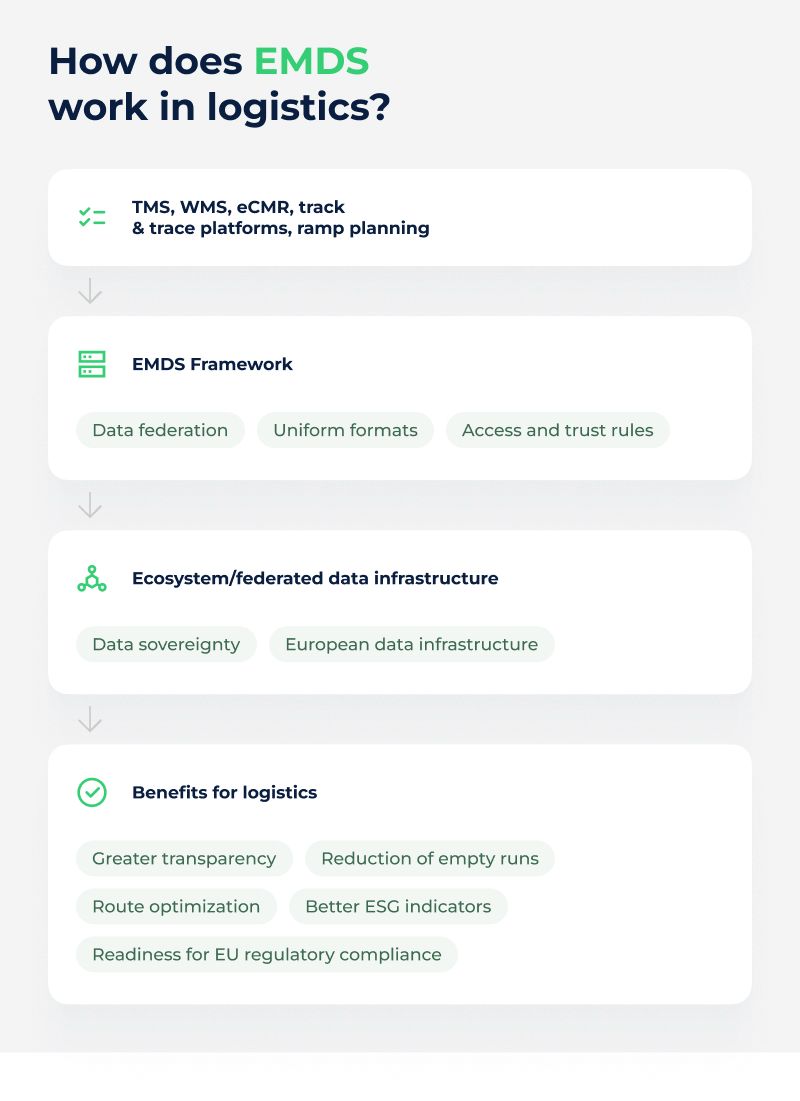
The diagram below illustrates the role of EMDS in the logistics ecosystem.