 Freight Allocation
 Real-time Visibility
 Time Slot Management
 Performance & Market Reports
 Agriculture
 Steel & Construction
 FMCG
FMCG Automotive
 Paper & Packaging
 Retail
 Wood & Furniture
 Case Studies
 Blog
Blog Reports



The coordination and allocation of transport orders to each supplier are often complex processes and, without good management, can lead to bottlenecks, errors and, ultimately, additional costs.
Given the forthcoming European directives that promote sustainability, it is not surprising that they will also do so through hyperconnectivity, digitalization of documents such as the eCMR and transparency of emissions, allowing companies to have clearer control over their environmental impact.
However, for the logistics sector, sustainability is not only about reducing emissions, but extends to the way companies manage their resources, how they treat their employees and how they interact with their communities, known as ESG (Environmental, Social and Governance).
In terms of efficient management of the supply chain, which involves multiple actors, from suppliers to customers and transporters, cooperation is key to the pursuit of this 360º sustainability. It is no longer enough for each company to optimize its processes in isolation; the real change comes when all links in the supply chain, from suppliers to carriers and customers, work together in a coordinated manner.
Let’s explore how technology can solve the communication problems that often arise:
1. Communication simplification and elimination of redundancy
One of the most frequent problems in the assignment of transport orders is the lack of a unified channel for communication. Shippers find themselves having to send multiple emails and make phone calls to confirm details, adjust timelines and ensure that everything is in order. This can be especially problematic when orders are handled manually and there is no centralized system.
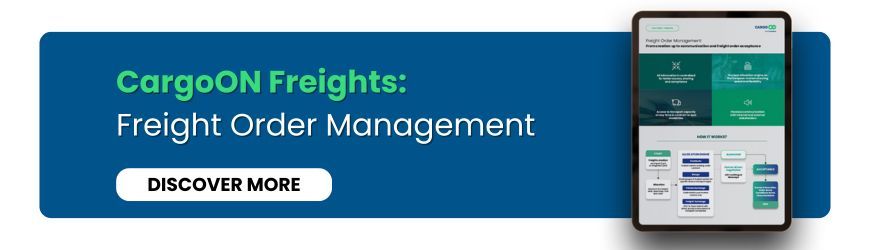
CargoON’s Freights module allows you to manage all transport orders in one place, eliminating the need for separate tools or multiple channels as it easily integrates via API to your TMS or ERP. This means that we can act as connectivity from, for example, SAP assigning the order to the carrier they already have determined or play with the algorithm and allocation according to availability and best price and route. All this facilitates communication between shippers and carriers, reducing duplications and avoiding confusion in the allocation and confirmation processes.
2. Automated Order Assignment: Saving Time and Accuracy
Assigning transport orders manually is often a time-consuming process, especially when it comes to analyzing each carrier’s availability, cost and transit times. With a digital solution like Freights, the shipper can automate this assignment, which not only speeds up the process, but also allows shippers to take full advantage of their suppliers’ capacity, distributing freight more effectively, reducing the risk of delays and empty miles, and pre-planning several transports at once for fractional delivery.